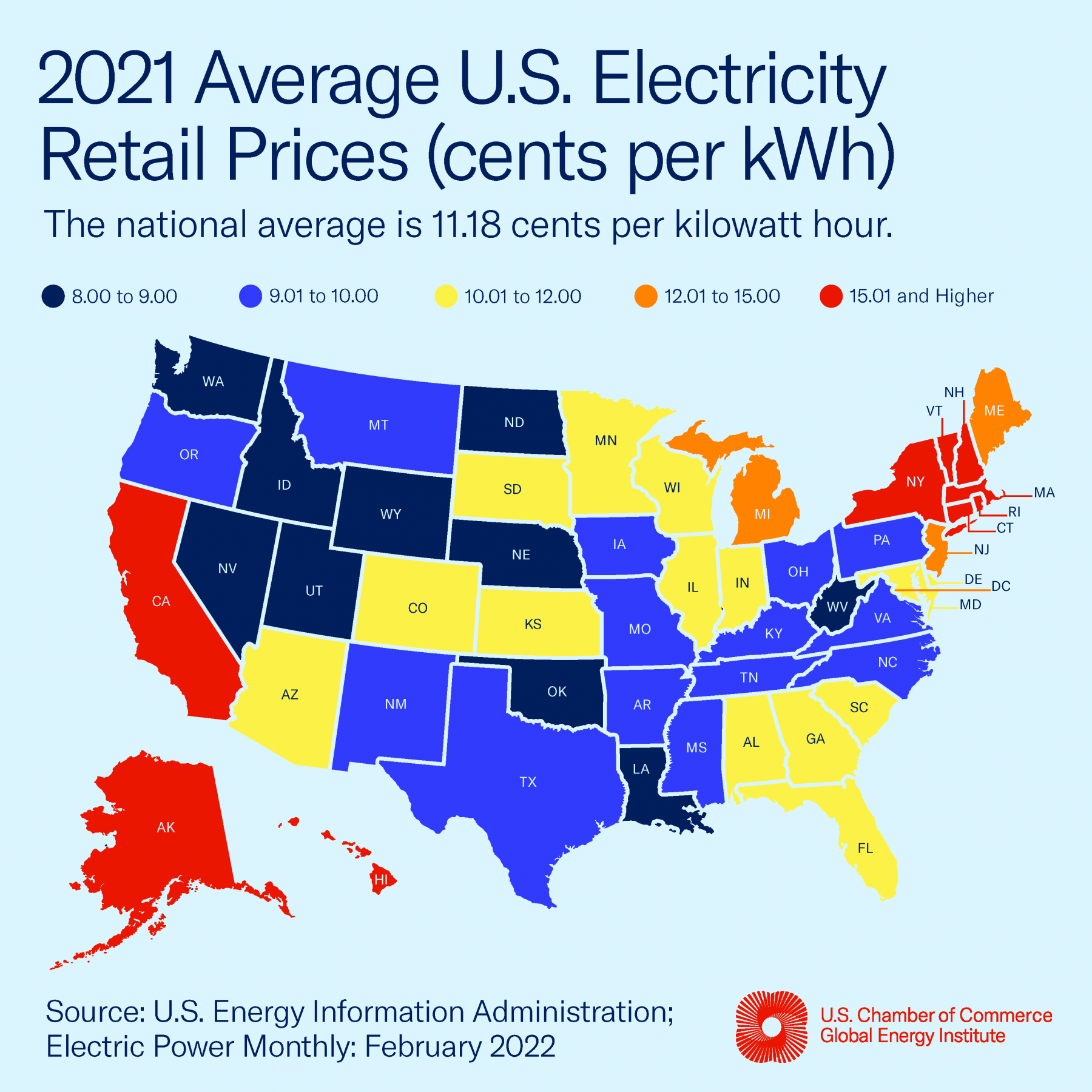
2025 Electricity Price Map
Published
May 05, 2026
New 2025 data from the U.S. Energy Information Administration (EIA) shows Americans are paying 22% more for electricity than they were just five years ago. But that national number masks enormous state-by-state differences. In some states, prices have barely budged. In others, they've skyrocketed, driven by infrastructure bottlenecks, aggressive policy mandates, and limited access to affordable fuel.
The Chamber's Global Energy Institute (GEI) has been tracking these trends for years, and the 2025 numbers make the pattern clearer than ever. Here's what's happening, why, and what it means for your wallet.
2025 Average U.S. Electricity Prices*
Click on a state to explore 2025 average electricity prices
Alabama
-
12.62 cents
Alabama's average electricity price per kilowatt hour is BELOW the national average of 13.63 / kwh.
-
8.89%
Alabama's cost for electricity has INCREASED over three years
-
28.25%
Alabama's cost for electricity has INCREASED over five years
- Residential: 16.1
- Commercial: 14.52
- Industrial: 7.73
- Transportation: NA
Alaska
-
23.05 cents
Alaska's average electricity price per kilowatt hour is ABOVE the national average of 13.63 / kwh.
-
11.19%
Alaska's cost for electricity has INCREASED over three years
-
16.3%
Alaska's cost for electricity has INCREASED over five years
- Residential: 26.09
- Commercial: 22.32
- Industrial: 20.03
- Transportation: NA
Arizona
-
12.97 cents
Arizona's average electricity price per kilowatt hour is BELOW the national average of 13.63 / kwh.
-
14.68%
Arizona's cost for electricity has INCREASED over three years
-
24.23%
Arizona's cost for electricity has INCREASED over five years
- Residential: 15.32
- Commercial: 12.47
- Industrial: 8.1
- Transportation: 11.07
Arkansas
-
9.84 cents
Arkansas's average electricity price per kilowatt hour is BELOW the national average of 13.63 / kwh.
-
-0.71%
Arkansas's cost for electricity has DECREASED over three years
-
18.27%
Arkansas's cost for electricity has INCREASED over five years
- Residential: 12.84
- Commercial: 10.76
- Industrial: 6.71
- Transportation: 13.12
California
-
27.63 cents
California's average electricity price per kilowatt hour is ABOVE the national average of 13.63 / kwh.
-
23.73%
California's cost for electricity has INCREASED over three years
-
53.5%
California's cost for electricity has INCREASED over five years
- Residential: 32.54
- Commercial: 26.36
- Industrial: 21.62
- Transportation: 17.08
Colorado
-
12.77 cents
Colorado's average electricity price per kilowatt hour is BELOW the national average of 13.63 / kwh.
-
8.68%
Colorado's cost for electricity has INCREASED over three years
-
24.34%
Colorado's cost for electricity has INCREASED over five years
- Residential: 15.85
- Commercial: 12.47
- Industrial: 9.07
- Transportation: 9.6
Connecticut
-
25.68 cents
Connecticut's average electricity price per kilowatt hour is ABOVE the national average of 13.63 / kwh.
-
21.82%
Connecticut's cost for electricity has INCREASED over three years
-
34.24%
Connecticut's cost for electricity has INCREASED over five years
- Residential: 29.38
- Commercial: 23.11
- Industrial: 18.35
- Transportation: 18.36
Delaware
-
14.19 cents
Delaware's average electricity price per kilowatt hour is ABOVE the national average of 13.63 / kwh.
-
19.95%
Delaware's cost for electricity has INCREASED over three years
-
38.57%
Delaware's cost for electricity has INCREASED over five years
- Residential: 17.13
- Commercial: 12.64
- Industrial: 9.64
- Transportation: NA
District of Columbia
-
20.34 cents
District of Columbia's average electricity price per kilowatt hour is ABOVE the national average of 13.63 / kwh.
-
36.14%
District of Columbia's cost for electricity has INCREASED over three years
-
70.92%
District of Columbia's cost for electricity has INCREASED over five years
- Residential: 21.94
- Commercial: 20.41
- Industrial: 14.78
- Transportation: 10.08
Florida
-
13.34 cents
Florida's average electricity price per kilowatt hour is BELOW the national average of 13.63 / kwh.
-
6.63%
Florida's cost for electricity has INCREASED over three years
-
32.6%
Florida's cost for electricity has INCREASED over five years
- Residential: 15.24
- Commercial: 11.47
- Industrial: 8.84
- Transportation: 10.93
Georgia
-
12.03 cents
Georgia's average electricity price per kilowatt hour is BELOW the national average of 13.63 / kwh.
-
0.25%
Georgia's cost for electricity has INCREASED over three years
-
21.15%
Georgia's cost for electricity has INCREASED over five years
- Residential: 14.73
- Commercial: 11.5
- Industrial: 7.81
- Transportation: 7.88
Hawaii
-
35.72 cents
Hawaii's average electricity price per kilowatt hour is ABOVE the national average of 13.63 / kwh.
-
-10.07%
Hawaii's cost for electricity has DECREASED over three years
-
29.66%
Hawaii's cost for electricity has INCREASED over five years
- Residential: 40.59
- Commercial: 36.37
- Industrial: 31.46
- Transportation: NA
Idaho
-
9.74 cents
Idaho's average electricity price per kilowatt hour is BELOW the national average of 13.63 / kwh.
-
14.45%
Idaho's cost for electricity has INCREASED over three years
-
21.9%
Idaho's cost for electricity has INCREASED over five years
- Residential: 11.82
- Commercial: 9.25
- Industrial: 7.98
- Transportation: NA
Illinois
-
13.74 cents
Illinois's average electricity price per kilowatt hour is ABOVE the national average of 13.63 / kwh.
-
15.08%
Illinois's cost for electricity has INCREASED over three years
-
40.92%
Illinois's cost for electricity has INCREASED over five years
- Residential: 17.69
- Commercial: 13.07
- Industrial: 10.14
- Transportation: 8.85
Indiana
-
12.57 cents
Indiana's average electricity price per kilowatt hour is BELOW the national average of 13.63 / kwh.
-
7.8%
Indiana's cost for electricity has INCREASED over three years
-
26.71%
Indiana's cost for electricity has INCREASED over five years
- Residential: 16.23
- Commercial: 13.88
- Industrial: 8.89
- Transportation: 13.76
Iowa
-
9.76 cents
Iowa's average electricity price per kilowatt hour is BELOW the national average of 13.63 / kwh.
-
1.99%
Iowa's cost for electricity has INCREASED over three years
-
8.81%
Iowa's cost for electricity has INCREASED over five years
- Residential: 13.72
- Commercial: 11.05
- Industrial: 7.2
- Transportation: NA
Kansas
-
11.52 cents
Kansas's average electricity price per kilowatt hour is BELOW the national average of 13.63 / kwh.
-
0.44%
Kansas's cost for electricity has INCREASED over three years
-
10.98%
Kansas's cost for electricity has INCREASED over five years
- Residential: 14.56
- Commercial: 11.35
- Industrial: 8.03
- Transportation: NA
Kentucky
-
10.55 cents
Kentucky's average electricity price per kilowatt hour is BELOW the national average of 13.63 / kwh.
-
0.38%
Kentucky's cost for electricity has INCREASED over three years
-
22.96%
Kentucky's cost for electricity has INCREASED over five years
- Residential: 13.24
- Commercial: 11.88
- Industrial: 6.96
- Transportation: NA
Louisiana
-
9.5 cents
Louisiana's average electricity price per kilowatt hour is BELOW the national average of 13.63 / kwh.
-
-8.74%
Louisiana's cost for electricity has DECREASED over three years
-
26.5%
Louisiana's cost for electricity has INCREASED over five years
- Residential: 12.57
- Commercial: 11.2
- Industrial: 6.23
- Transportation: 11.15
Maine
-
22.81 cents
Maine's average electricity price per kilowatt hour is ABOVE the national average of 13.63 / kwh.
-
30.79%
Maine's cost for electricity has INCREASED over three years
-
68.46%
Maine's cost for electricity has INCREASED over five years
- Residential: 27.78
- Commercial: 20.96
- Industrial: 15.5
- Transportation: NA
Maryland
-
16.83 cents
Maryland's average electricity price per kilowatt hour is ABOVE the national average of 13.63 / kwh.
-
26.35%
Maryland's cost for electricity has INCREASED over three years
-
50.94%
Maryland's cost for electricity has INCREASED over five years
- Residential: 19.48
- Commercial: 14.74
- Industrial: 12.5
- Transportation: 13.42
Massachusetts
-
25.56 cents
Massachusetts's average electricity price per kilowatt hour is ABOVE the national average of 13.63 / kwh.
-
20.17%
Massachusetts's cost for electricity has INCREASED over three years
-
40.52%
Massachusetts's cost for electricity has INCREASED over five years
- Residential: 30.48
- Commercial: 23.08
- Industrial: 19.35
- Transportation: 9.43
Michigan
-
14.73 cents
Michigan's average electricity price per kilowatt hour is ABOVE the national average of 13.63 / kwh.
-
11.59%
Michigan's cost for electricity has INCREASED over three years
-
20.64%
Michigan's cost for electricity has INCREASED over five years
- Residential: 20.01
- Commercial: 14.48
- Industrial: 8.59
- Transportation: 13.67
Minnesota
-
12.67 cents
Minnesota's average electricity price per kilowatt hour is BELOW the national average of 13.63 / kwh.
-
5.23%
Minnesota's cost for electricity has INCREASED over three years
-
19.87%
Minnesota's cost for electricity has INCREASED over five years
- Residential: 15.82
- Commercial: 12.27
- Industrial: 9.32
- Transportation: 12.65
Mississippi
-
11.57 cents
Mississippi's average electricity price per kilowatt hour is BELOW the national average of 13.63 / kwh.
-
11.68%
Mississippi's cost for electricity has INCREASED over three years
-
26.73%
Mississippi's cost for electricity has INCREASED over five years
- Residential: 14.03
- Commercial: 13.03
- Industrial: 7.38
- Transportation: NA
Missouri
-
11.57 cents
Missouri's average electricity price per kilowatt hour is BELOW the national average of 13.63 / kwh.
-
12.77%
Missouri's cost for electricity has INCREASED over three years
-
20.02%
Missouri's cost for electricity has INCREASED over five years
- Residential: 13.49
- Commercial: 10.63
- Industrial: 8.38
- Transportation: 11.22
Montana
-
10.9 cents
Montana's average electricity price per kilowatt hour is BELOW the national average of 13.63 / kwh.
-
9.33%
Montana's cost for electricity has INCREASED over three years
-
19.39%
Montana's cost for electricity has INCREASED over five years
- Residential: 12.98
- Commercial: 11.88
- Industrial: 7.02
- Transportation: NA
Nebraska
-
9.55 cents
Nebraska's average electricity price per kilowatt hour is BELOW the national average of 13.63 / kwh.
-
8.15%
Nebraska's cost for electricity has INCREASED over three years
-
6.47%
Nebraska's cost for electricity has INCREASED over five years
- Residential: 12.34
- Commercial: 8.79
- Industrial: 8
- Transportation: NA
Nevada
-
10.31 cents
Nevada's average electricity price per kilowatt hour is BELOW the national average of 13.63 / kwh.
-
-5.76%
Nevada's cost for electricity has DECREASED over three years
-
23.77%
Nevada's cost for electricity has INCREASED over five years
- Residential: 13.15
- Commercial: 9.36
- Industrial: 8.08
- Transportation: 9.19
New Hampshire
-
21.59 cents
New Hampshire's average electricity price per kilowatt hour is ABOVE the national average of 13.63 / kwh.
-
2.47%
New Hampshire's cost for electricity has INCREASED over three years
-
29.83%
New Hampshire's cost for electricity has INCREASED over five years
- Residential: 24.56
- Commercial: 20.16
- Industrial: 16.88
- Transportation: NA
New Jersey
-
18.84 cents
New Jersey's average electricity price per kilowatt hour is ABOVE the national average of 13.63 / kwh.
-
27.3%
New Jersey's cost for electricity has INCREASED over three years
-
38.22%
New Jersey's cost for electricity has INCREASED over five years
- Residential: 22.63
- Commercial: 16.63
- Industrial: 13.9
- Transportation: 11.92
New Mexico
-
9.56 cents
New Mexico's average electricity price per kilowatt hour is BELOW the national average of 13.63 / kwh.
-
-4.59%
New Mexico's cost for electricity has DECREASED over three years
-
2.47%
New Mexico's cost for electricity has INCREASED over five years
- Residential: 15.08
- Commercial: 11.23
- Industrial: 5.9
- Transportation: NA
New York
-
21.62 cents
New York's average electricity price per kilowatt hour is ABOVE the national average of 13.63 / kwh.
-
17.95%
New York's cost for electricity has INCREASED over three years
-
45.39%
New York's cost for electricity has INCREASED over five years
- Residential: 26.39
- Commercial: 21.07
- Industrial: 9.55
- Transportation: 16.87
North Carolina
-
11.53 cents
North Carolina's average electricity price per kilowatt hour is BELOW the national average of 13.63 / kwh.
-
20.1%
North Carolina's cost for electricity has INCREASED over three years
-
22.27%
North Carolina's cost for electricity has INCREASED over five years
- Residential: 14.02
- Commercial: 10.25
- Industrial: 7.8
- Transportation: 9.81
North Dakota
-
8.2 cents
North Dakota's average electricity price per kilowatt hour is BELOW the national average of 13.63 / kwh.
-
-2.61%
North Dakota's cost for electricity has DECREASED over three years
-
-3.87%
North Dakota's cost for electricity has DECREASED over five years
- Residential: 11.81
- Commercial: 7.4
- Industrial: 7.5
- Transportation: NA
Ohio
-
12.43 cents
Ohio's average electricity price per kilowatt hour is BELOW the national average of 13.63 / kwh.
-
16.82%
Ohio's cost for electricity has INCREASED over three years
-
31.67%
Ohio's cost for electricity has INCREASED over five years
- Residential: 16.96
- Commercial: 11.6
- Industrial: 8.52
- Transportation: 9.74
Oklahoma
-
9.5 cents
Oklahoma's average electricity price per kilowatt hour is BELOW the national average of 13.63 / kwh.
-
-5.47%
Oklahoma's cost for electricity has DECREASED over three years
-
24.51%
Oklahoma's cost for electricity has INCREASED over five years
- Residential: 13.12
- Commercial: 9.08
- Industrial: 6.15
- Transportation: NA
Oregon
-
11.51 cents
Oregon's average electricity price per kilowatt hour is BELOW the national average of 13.63 / kwh.
-
24.3%
Oregon's cost for electricity has INCREASED over three years
-
30.5%
Oregon's cost for electricity has INCREASED over five years
- Residential: 15.37
- Commercial: 10.56
- Industrial: 8.28
- Transportation: 13.72
Pennsylvania
-
14.11 cents
Pennsylvania's average electricity price per kilowatt hour is ABOVE the national average of 13.63 / kwh.
-
18.97%
Pennsylvania's cost for electricity has INCREASED over three years
-
45.46%
Pennsylvania's cost for electricity has INCREASED over five years
- Residential: 19.3
- Commercial: 12.44
- Industrial: 9.36
- Transportation: 9.32
Rhode Island
-
25.86 cents
Rhode Island's average electricity price per kilowatt hour is ABOVE the national average of 13.63 / kwh.
-
33.99%
Rhode Island's cost for electricity has INCREASED over three years
-
39.48%
Rhode Island's cost for electricity has INCREASED over five years
- Residential: 29.46
- Commercial: 23.46
- Industrial: 21.74
- Transportation: 23.3
South Carolina
-
11.45 cents
South Carolina's average electricity price per kilowatt hour is BELOW the national average of 13.63 / kwh.
-
6.61%
South Carolina's cost for electricity has INCREASED over three years
-
15.66%
South Carolina's cost for electricity has INCREASED over five years
- Residential: 14.96
- Commercial: 11.05
- Industrial: 7.11
- Transportation: NA
South Dakota
-
11.35 cents
South Dakota's average electricity price per kilowatt hour is BELOW the national average of 13.63 / kwh.
-
8.72%
South Dakota's cost for electricity has INCREASED over three years
-
12.82%
South Dakota's cost for electricity has INCREASED over five years
- Residential: 13.38
- Commercial: 10.89
- Industrial: 8.68
- Transportation: NA
Tennessee
-
11.57 cents
Tennessee's average electricity price per kilowatt hour is BELOW the national average of 13.63 / kwh.
-
6.24%
Tennessee's cost for electricity has INCREASED over three years
-
21.53%
Tennessee's cost for electricity has INCREASED over five years
- Residential: 13.18
- Commercial: 12.87
- Industrial: 6.74
- Transportation: NA
Texas
-
10.18 cents
Texas's average electricity price per kilowatt hour is BELOW the national average of 13.63 / kwh.
-
0.2%
Texas's cost for electricity has INCREASED over three years
-
21.77%
Texas's cost for electricity has INCREASED over five years
- Residential: 15.47
- Commercial: 8.64
- Industrial: 6.55
- Transportation: 3.81
Utah
-
10.67 cents
Utah's average electricity price per kilowatt hour is BELOW the national average of 13.63 / kwh.
-
21.25%
Utah's cost for electricity has INCREASED over three years
-
29.02%
Utah's cost for electricity has INCREASED over five years
- Residential: 13.07
- Commercial: 10.04
- Industrial: 8.43
- Transportation: 12.64
Vermont
-
19.39 cents
Vermont's average electricity price per kilowatt hour is ABOVE the national average of 13.63 / kwh.
-
14.13%
Vermont's cost for electricity has INCREASED over three years
-
18.74%
Vermont's cost for electricity has INCREASED over five years
- Residential: 22.92
- Commercial: 19.92
- Industrial: 12.39
- Transportation: NA
Virginia
-
11.41 cents
Virginia's average electricity price per kilowatt hour is BELOW the national average of 13.63 / kwh.
-
6.14%
Virginia's cost for electricity has INCREASED over three years
-
24.56%
Virginia's cost for electricity has INCREASED over five years
- Residential: 15.28
- Commercial: 9.55
- Industrial: 9.45
- Transportation: 9.38
Washington
-
11.06 cents
Washington's average electricity price per kilowatt hour is BELOW the national average of 13.63 / kwh.
-
22.21%
Washington's cost for electricity has INCREASED over three years
-
32.77%
Washington's cost for electricity has INCREASED over five years
- Residential: 13.11
- Commercial: 10.95
- Industrial: 6.88
- Transportation: 12.27
West Virginia
-
11.4 cents
West Virginia's average electricity price per kilowatt hour is BELOW the national average of 13.63 / kwh.
-
17.04%
West Virginia's cost for electricity has INCREASED over three years
-
30.29%
West Virginia's cost for electricity has INCREASED over five years
- Residential: 15.41
- Commercial: 11.75
- Industrial: 8.11
- Transportation: NA
Wisconsin
-
13.35 cents
Wisconsin's average electricity price per kilowatt hour is BELOW the national average of 13.63 / kwh.
-
11.72%
Wisconsin's cost for electricity has INCREASED over three years
-
23.38%
Wisconsin's cost for electricity has INCREASED over five years
- Residential: 18.16
- Commercial: 13.06
- Industrial: 8.92
- Transportation: 17.88
Wyoming
-
9.75 cents
Wyoming's average electricity price per kilowatt hour is BELOW the national average of 13.63 / kwh.
-
18.33%
Wyoming's cost for electricity has INCREASED over three years
-
17.9%
Wyoming's cost for electricity has INCREASED over five years
- Residential: 13.38
- Commercial: 9.54
- Industrial: 8.66
- Transportation: NA
*Prices in cents per kWh.
Source: U.S. Energy Information Administration: Electric Power Monthly: March, 2026
The Big Picture
On average, Americans now pay 13.63 cents per kilowatt-hour (¢/kWh) for electricity, up 5% from 2024 and 22% over the past five years. These increases are impacting household budgets everywhere.
But the rising national average only tells part of the story. Some states are weathering these increases better than others, and the reasons come down to how they generate power, how they move it, and what rules govern the process.
Without any doubt, electricity demand is increasing faster than it has in decades, with increased manufacturing and new AI infrastructure propelling this growth. Some are connecting these dots to mean that increased demand is causing higher electricity prices. However, the price map demonstrates that a greater concentration of data centers, for example, does not equate to a state bearing an increased electricity cost burden. In fact, if you look at Virginia, Texas, and North Carolina, three of the biggest data center hubs in the country, these states still enjoy electricity rates well below the national average. Instead, the real cost drivers are different: generation mix, infrastructure capacity, and state-level policy decisions.
On the bright side, a few states (Nevada, Hawaii, and rapidly growing North Carolina) actually saw their rates drop in 2025, driven in large part by lower fuel prices.
Who's Paying the Most (and Least)?
Northeast & West Coast: The Expensive Zip Codes
If you live in the Northeast or along the West Coast, odds are you're paying some of the highest electricity prices in the country, and they keep climbing.
California hit 27.63 ¢/kWh in 2025, up 12% in three years and 40% over five. Rhode Island has seen the same 40% five-year jump. New York landed at 21.62 ¢/kWh, up 18% in three years and 34% over five.
What's behind it? A combination of carbon pricing programs, limited natural gas pipelines, and ambitious renewable energy goals that demand new resource investments and expensive grid overhauls. The exceptions worth noting are Washington and Oregon, where plentiful hydroelectric power keeps rates comfortably below the national average.
Energy-Producing States: Holding Steady
States with abundant energy resources have kept prices remarkably stable.
Wyoming came in at 9.75 ¢/kWh, reflecting a more measured 3.6% annual average increase over the past five years. North Dakota actually posted a slight decrease in electricity costs over that same stretch, one of the only states in the country that can say that. Local resources and a friendlier, pro-growth regulatory environment are supporting lower rates here.
Southeast & Midwest: The Middle Ground
These regions have seen moderate bumps while staying well below the high-cost zones.
Tennessee and Missouri both landed at 11.57 ¢/kWh, each up 17% over five years. Affordable natural gas, coal, and wind, paired with policies that welcome new infrastructure, have kept these states on more stable footing.
So What's Actually Driving Prices Up?
Natural Gas Access (or Lack of It)
Natural gas is still the country's top fuel for generating electricity, so access to it matters enormously. States sitting on top of shale gas reserves, like Pennsylvania and Ohio, have seen relatively modest price increases, around 12% over three years. States that can't get enough gas piped in, especially across New England, are paying more for limited supply.
The Price Tag on Rapid Transition
The states pushing hardest toward renewables (California, New York, and much of New England) and accelerating the retirement of existing generators are also paying the most for their electricity. Grid upgrades, carbon caps, managing the intermittency of wind and solar, and backfilling for generation retirements all cost money, and those costs are landing on ratepayers.
Infrastructure That Can't Keep Up
New transmission lines, pipelines, and power plants are overdue, but permitting delays and litigation are making things worse. When electricity can't get where it’s needed, prices go up. Maine is Exhibit A: average prices hit 22.81 ¢/kWh in 2025, a staggering 62% increase over five years.
Policy Choices, More Than Anything Else
This is the thread running through all of it. States with restrictive energy policies and aggressive climate mandates have generally seen the steepest price hikes. States with pro-growth, all-of-the-above approaches have managed to hold costs down, even as demand surges from manufacturing and data center expansion.
What Needs to Happen?
The 2025 data drives home one point above all: rising demand alone doesn't determine what you pay for electricity. What matters is whether your state has affordable fuel, the infrastructure to deliver it, and policies that don't stack unnecessary costs onto ratepayers.
Going forward, policymakers need to get serious about building critical infrastructure (transmission lines, pipelines, and generation plants) and cutting through the permitting red tape that stalls progress on all types of projects. A balanced energy mix that includes renewables, natural gas, nuclear, and other resources isn't just good policy; it's the only realistic path to keeping electricity both clean and affordable.
The states that figure this out will keep bills manageable. The ones that don't will keep watching their residents’ power bills climb.
Explore the electricity retail price maps from previous years: 2013, 2014, 2015, 2016, 2017, 2018, 2019, 2020, 2021, 2022, 2023 and 2024.
2025 Electricity Price Map
About the author

Heath Knakmuhs
Knakmuhs studies, develops, and communicates strategic energy policies and initiatives with a focus on the electric power sector. He also examines the impact of regulatory action, market-based factors, and emerging threats on the American electric grid.